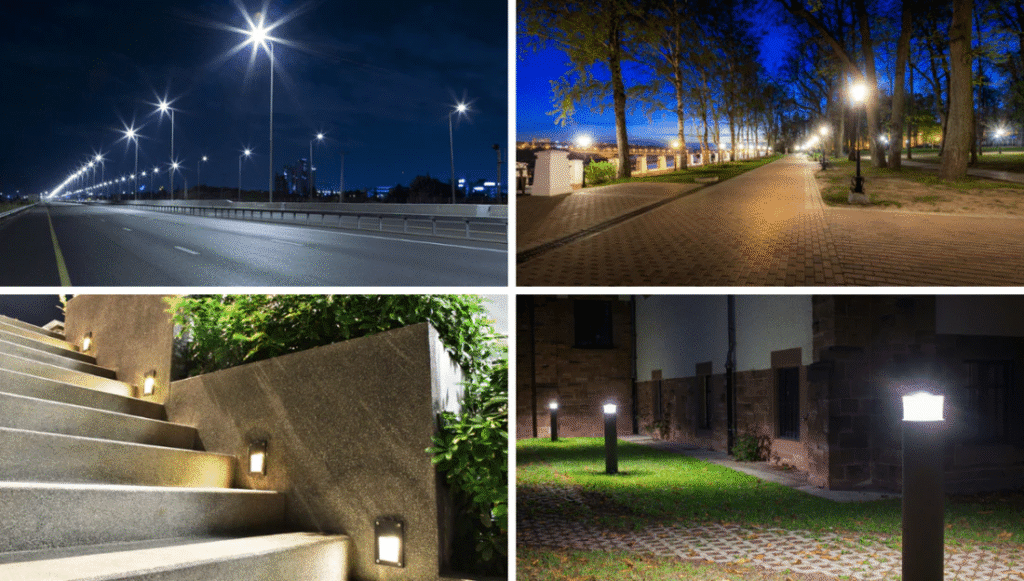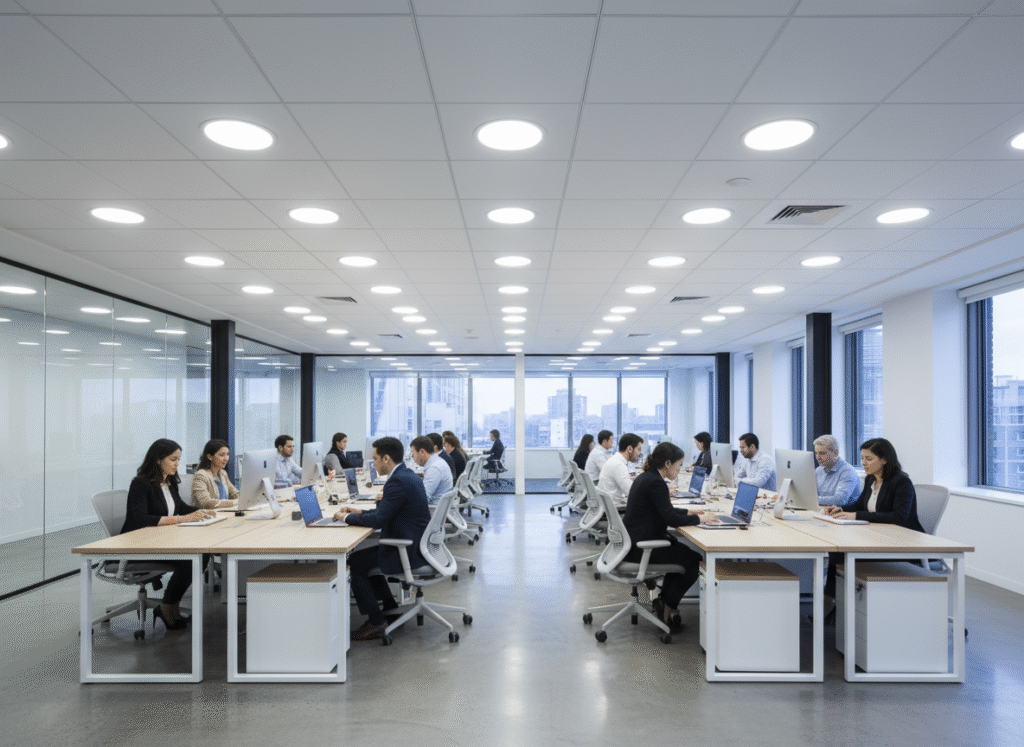
When comparing COB vs SMD LED Downlights, many office owners and facility managers wonder which technology delivers the best results for modern workspaces. In the world of modern lighting, especially in offices and workspaces, choosing the right type of LED Downlights makes a big difference in comfort, productivity, and even electricity bills. Today, we dive deep into COB vs SMD LED Downlights to see which one suits modern offices better.
What Are LED Downlights and Why Do Offices Need Them?
LED Downlights (or recessed spotlights in the ceiling) are the main lighting in most offices today. They provide downward-directed light that illuminates desks and corridors without taking up space, while giving a sleek and modern look.
Good lighting in offices is important because it:
- Reduces eye strain
- Increases focus and productivity
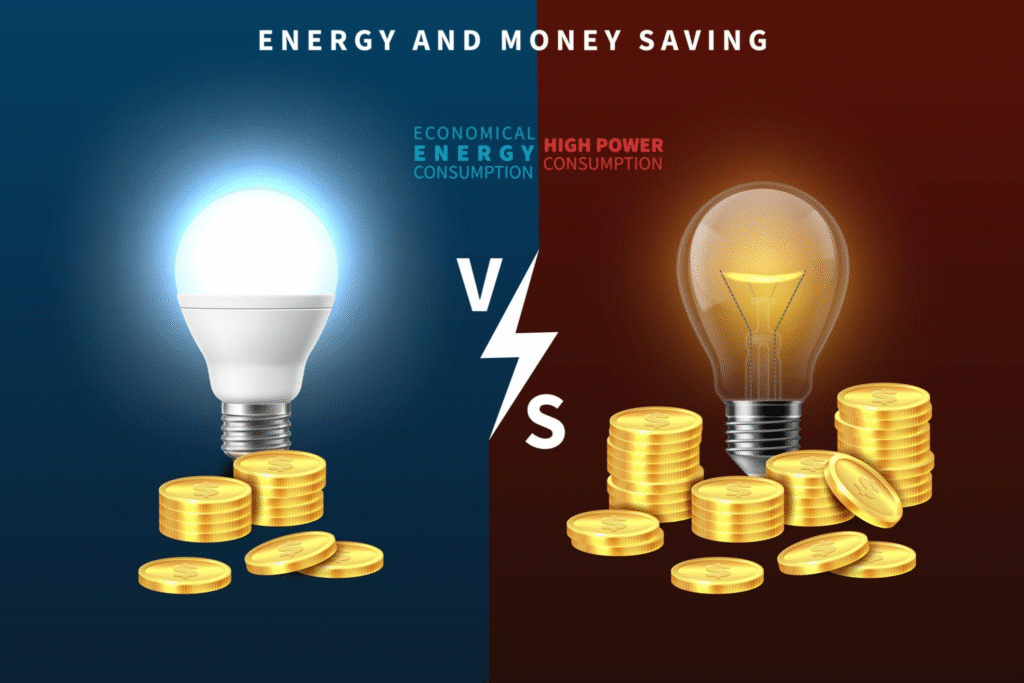
- Saves energy (LEDs save up to 80% compared to old bulbs)
- Lasts a long time (usually 50,000 hours or more)
The key question in any COB vs SMD LED Downlights discussion: what’s the real difference and which is better for the office environment?
Understanding COB LED Downlights
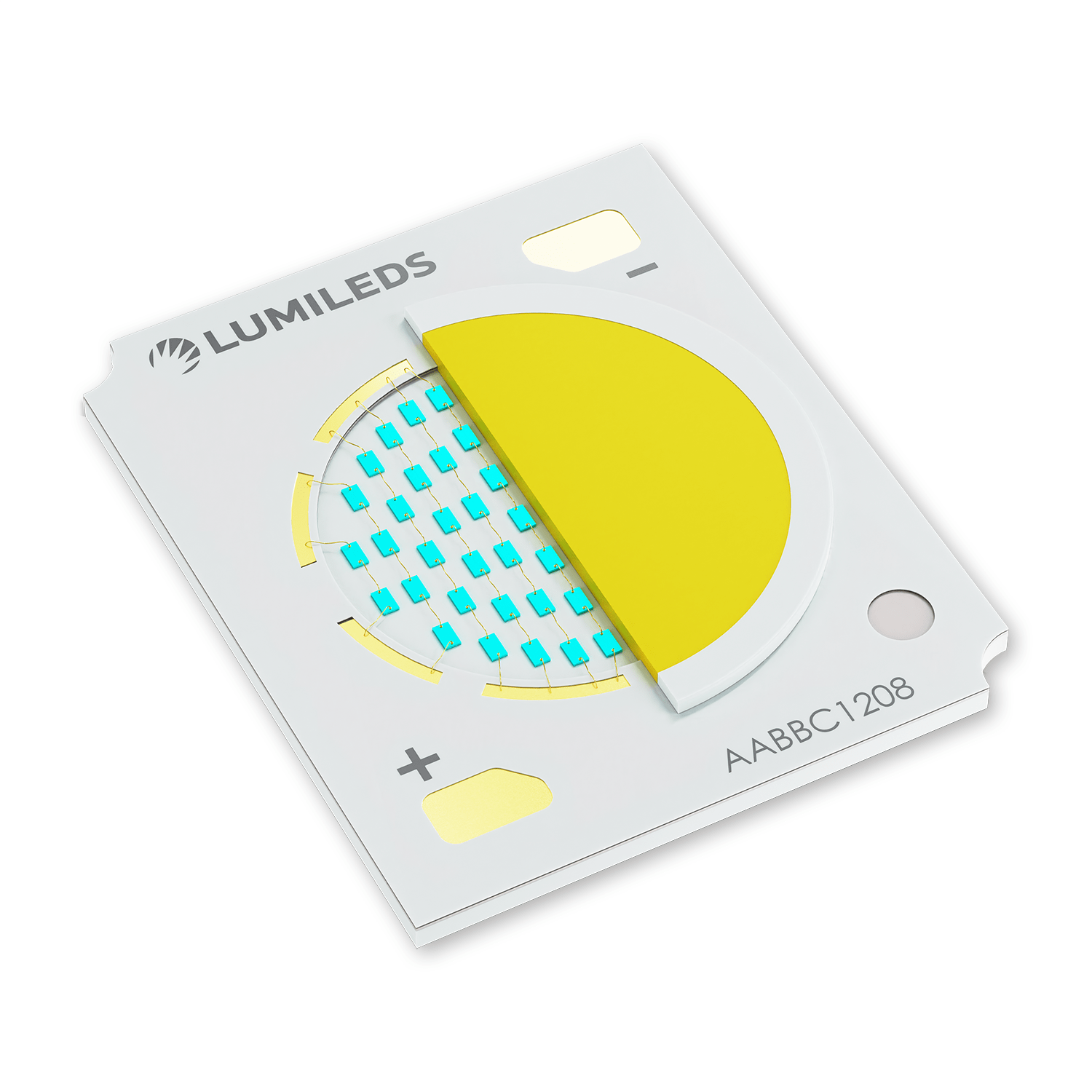
COB stands for Chip on Board. It means several small LED chips are packed closely together on one surface, covered by a single phosphor layer.
This makes the light come out as one large source, not separate points.
Advantages of COB LED Downlights in offices:

- Very uniform light without dots or multiple shadows – ideal so it doesn’t tire the eyes.
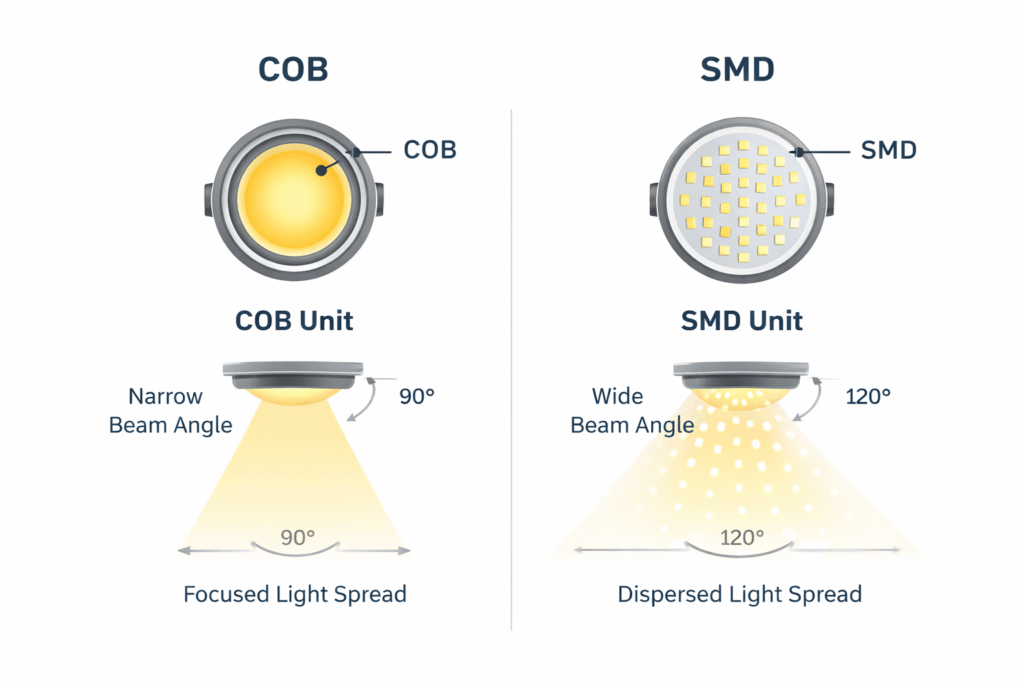
- Narrower beam angle (usually 30–60 degrees), meaning more focused lighting on the desk or specific area.
- High brightness in a small space, and excellent thermal efficiency (better heat dissipation due to the compact design).
- Sleek and “premium” appearance, making the office look more professional.
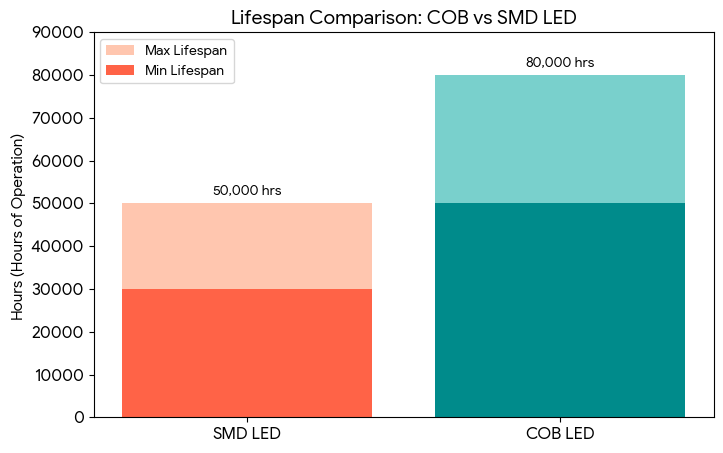
- Long lifespan (usually over 50,000–80,000 hours).
Disadvantages of COB:
- Slightly higher price at the start.
- May need a larger heatsink to cool properly during long use.
- For very wide lighting, you might need an extra diffuser.
Understanding SMD LED Downlights
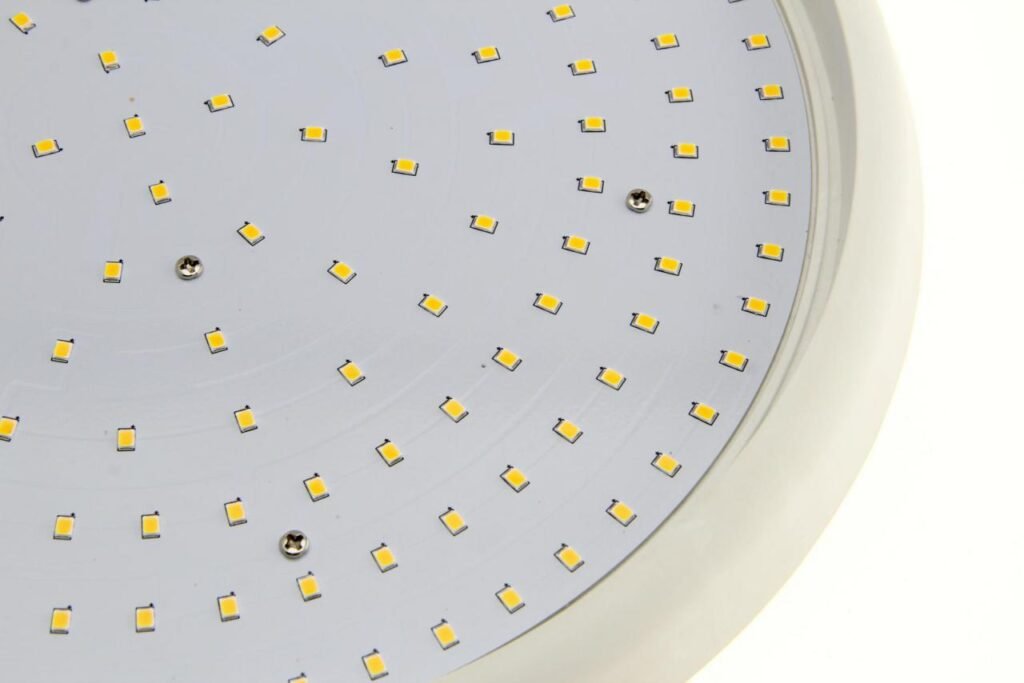
SMD stands for Surface Mounted Device. Each LED chip is separate and mounted on the surface, like many small points (such as 2835, 5730, or 5050).
The light comes from multiple points, so it usually needs a diffuser (plastic or glass cover) to make it smooth.
Advantages of SMD LED Downlights in offices:
- Wide and spread-out lighting (usually 90–120 degrees or more) – ideal for open-plan offices or corridors.
- Cheaper price, and widely available in the market.
- Greater design flexibility – you can change the number of chips or colors.
- Better heat distribution because the chips are spread out, so less heat during daily use.
- High lumens per watt efficiency in some modern models (up to 100–120 lm/W).
Disadvantages of SMD:
- Possible multiple shadows or glare if the diffuser is not good.
- Less focused light, so it may not suit tasks needing precise lighting (like reading or long computer work).
- Slightly shorter lifespan in some cases compared to high-quality COB.
Head-to-Head Comparison: COB vs SMD LED Downlights for Offices
| Criterion | COB LED Downlights | SMD LED Downlights | Winner for Modern Offices? |
|---|---|---|---|
| Uniformity & Glare | Very high, smooth light without dots | Good with diffuser, possible glare | COB |
| Beam Angle | Narrower (focused) | Wider (spread) | SMD for large spaces |
| Brightness & Focus | Higher focus | Higher distribution | Depends on use |
| Energy Efficiency | Excellent (80+ lm/W common) | Excellent too (up to 100+ lm/W) | Tie |
| Heat Dissipation | Very good due to design | Good due to spreading | Tie |
| Lifespan | 50,000–80,000+ hours | 30,000–50,000+ hours | COB |
| Cost | Slightly higher | Cheaper | SMD |
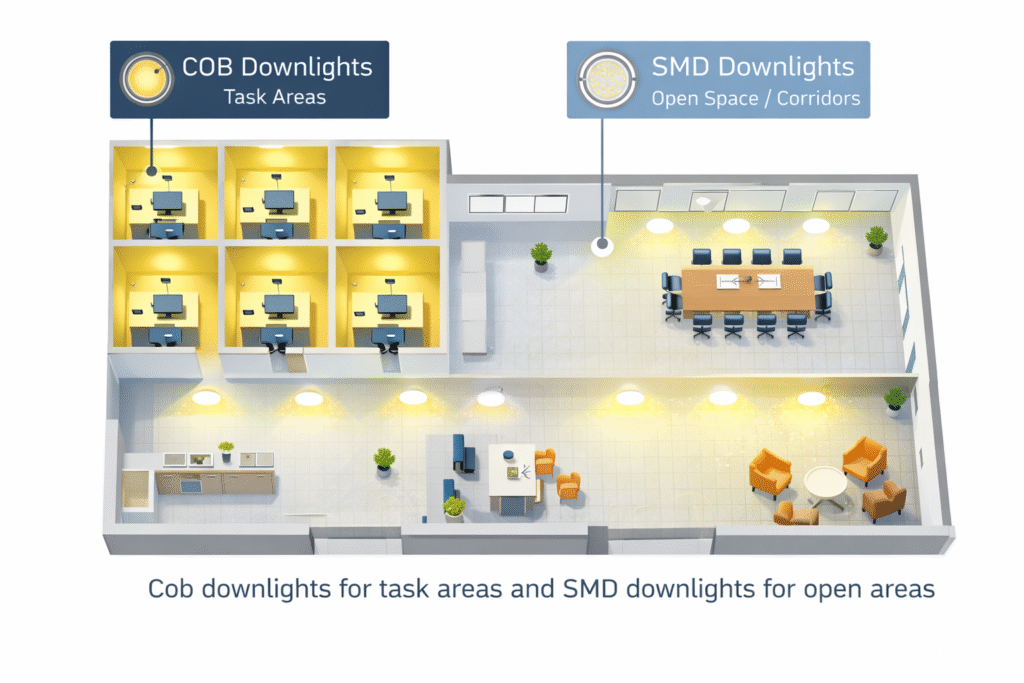
| Best For | Private offices, meeting rooms, task lighting | Open offices, corridors, ambient lighting | – |
From the table in this COB vs SMD LED Downlights comparison, it’s clear there is no absolute winner – but in modern offices (2026), the trend leans more toward COB because it provides higher eye comfort and better appearance.
Which One Wins for Modern Offices in 2026?
In most modern offices when evaluating COB vs SMD LED Downlights:
- If the office is a large open space or has long corridors: SMD LED Downlights are often better for wide lighting and suitable price.
- If it’s meeting rooms, private desks, or needs comfortable lighting without strain: COB LED Downlights win, because the smooth and uniform light reduces glare and boosts focus.
Many companies now use a mix: COB in areas needing concentration (like above desks), and SMD for general ceiling or ambient lighting.
Final Thoughts: Make the Smart Choice for Your Office
Lighting is not a luxury – it’s an investment in employee health and productivity. When choosing between COB vs SMD LED Downlights for your office:
- Focus on high CRI (above 80–90) so colors look real.
- Choose dimmable if you want to control the light.
- Look for low UGR (Unified Glare Rating) (less than 19) for eye comfort.
In the end, COB LED Downlights usually win in modern offices because they offer a more comfortable and professional lighting experience. But if the budget is limited or the space is very large, SMD is still an excellent choice in the COB vs SMD LED Downlights debate.
Frequently Asked Questions (FAQ)
Q: In COB vs SMD LED Downlights, which is better for reducing eye strain in offices?
COB is generally better because it provides smoother, more uniform light with less glare and no visible multiple light points, which helps reduce eye fatigue during long work hours.
Q: In COB vs SMD LED Downlights, which one is more energy-efficient?
Both are highly efficient (often 80–120 lm/W), but modern high-quality SMD models can edge out slightly in lumens per watt for widespread use. In practice, the difference is small when comparing good brands.
Q: In COB vs SMD LED Downlights, can I use COB downlights in a large open-plan office?
Yes, but you may need more fixtures or a wider beam version with a diffuser. SMD is usually easier and cheaper for covering large areas evenly.
Q: In COB vs SMD LED Downlights, do COB LED downlights last longer than SMD?
Yes, high-quality COB downlights often have a longer rated lifespan (50,000–80,000+ hours) thanks to better heat management in the compact design.
Q: In COB vs SMD LED Downlights, are SMD downlights always cheaper?
Yes, SMD downlights typically cost less upfront and are more widely available, making them ideal for budget-conscious office upgrades or large installations.
Q: In COB vs SMD LED Downlights, should I mix COB and SMD in the same office?
Absolutely – this is a popular hybrid approach: use COB for task areas (desks, meeting rooms) and SMD for ambient/general lighting (corridors, open spaces) to get the best of both.
Ready to Upgrade Your Office Lighting?
Don’t settle for outdated or uncomfortable lighting that hurts productivity. Whether you choose COB for premium comfort or SMD for wide coverage and value, the right LED downlights can transform your workspace.
Contact a trusted lighting supplier today, request samples, or consult an electrician to calculate the perfect setup for your office size and needs. Upgrade now and enjoy better focus, lower bills, and happier teams!
Sources
- Dothelight: COB vs SMD LEDs – Which is Right for Your Lighting Project?
- Vertex Light: What’s the difference between SMD LED downlight and COB?
- Radians Lighting: COB LED Downlights vs. SMD LED Downlights
- Tecolite: COB vs. SMD LED – Differences, Benefits & Best Applications
- Colbor: SMD VS COB LED – What are their differences