In recent years, when buying a light bulb, you see strange numbers on the package: 800 lumens, 9 watts, 2700 Kelvin… What do they mean?
In the past, we simply said, “Give me a 100-watt bulb,” and that was it. But with the rise of LED bulbs, wattage no longer determines brightness. What truly matters now is lumens—so you can always pick the Right LED Brightness for every room in your home without getting a bulb that’s too harsh (hurting your eyes) or too dim (leaving the room feeling dark).
What Are Watts? (It’s About Electricity, Not Brightness)
Watts measure how much electricity the bulb uses per hour.
- An old 60-watt incandescent bulb → consumes 60 watts.
- A modern LED bulb with the same brightness → often uses only 7–12 watts.
In short: Lower watts mean bigger savings on your electricity bill—but only if the lumens are enough to deliver the Right LED Brightness.
What Are Lumens? (This Is the Real Brightness You See)
Lumens measure the actual amount of visible light the bulb produces.
- 400 lumens → soft light (great for decoration or night lights).
- 800 lumens → medium brightness (similar to an old 60-watt bulb).
- 1600 lumens → strong, bright light (ideal for large kitchens or garages).
Golden rule in 2026: Always buy based on lumens to guarantee the Right LED Brightness every time.
Watt vs Lumen Comparison Table (2026 LED Equivalents)
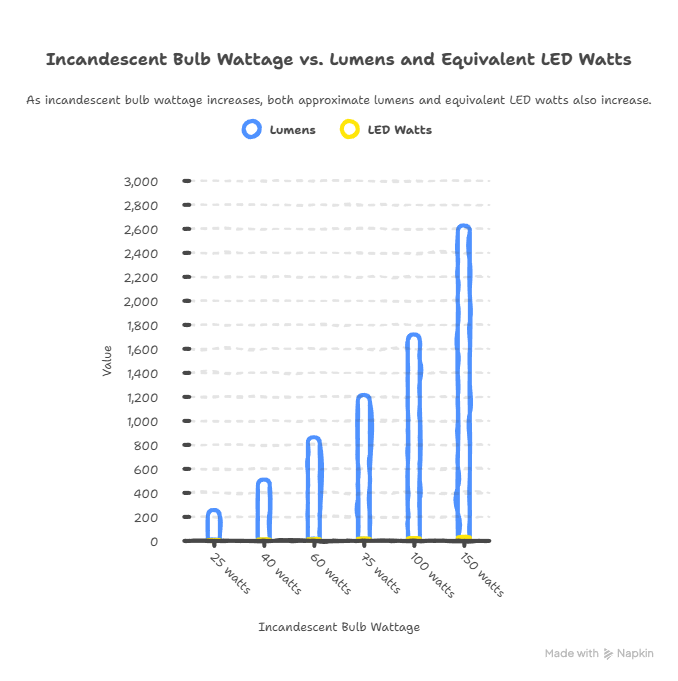
Based on current LED efficiency (90–150 lumens per watt in quality home bulbs):
| Old Incandescent Bulb | Approximate Lumens | Equivalent LED Watts (Approx.) | Best For (the Right LED Brightness) |
|---|---|---|---|
| 25 watts | 200–300 | 2–5 watts | Night lights, closets, decoration |
| 40 watts | 450–550 | 5–8 watts | Hallways, small bathrooms |
| 60 watts | 800–900 | 8–12 watts | Living rooms, small offices |
| 75 watts | 1100–1300 | 10–16 watts | Medium kitchens, large living rooms |
| 100 watts | 1600–1800 | 14–20 watts | Large kitchens, garages |
| 150 watts | 2600+ | 20–30 watts | Very large spaces or outdoor areas |
(Note: Always check the exact lumens printed on the package—these are approximate.)
How to Calculate the Right LED Brightness for Any Room
Simple formula: Room area (square meters) × Recommended lumens per square meter
Common guidelines (based on IES residential standards and modern lighting experts):
- Living room / Sitting area: 100–300 lumens per m² → A 20 m² room needs 2000–6000 total lumens.
- Kitchen: 300–750 lumens per m² → A 12 m² kitchen needs 3600–9000 lumens.
- Bedroom: 100–200 lumens per m² → A 15 m² bedroom needs 1500–3000 lumens.
- Bathroom: 200–500 lumens per m² (higher near mirrors) → A 6 m² bathroom needs 1200–3000 lumens.
Room-by-Room Guide to Choosing the Right LED Brightness
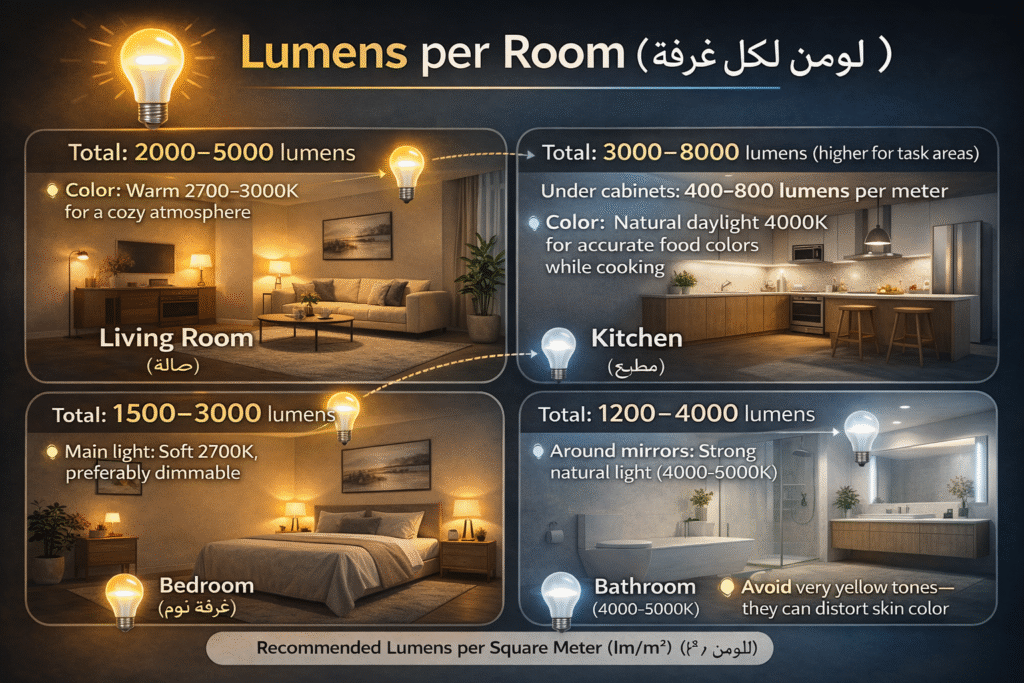
Living Room
- Total: 2000–5000 lumens
- Color: Warm 2700–3000K for a cozy atmosphere
- Tip: Use 2–4 bulbs + layered lighting (ceiling + floor lamps).
Kitchen
- Total: 3000–8000 lumens (higher for task areas)
- Under cabinets: 400–800 lumens per meter
- Tip: Natural daylight 4000K for accurate food colors while cooking.
Bedroom
- Total: 1500–3000 lumens
- Main light: Soft 2700K, preferably dimmable
- Tip: Bedside lamp 400–600 lumens for comfortable reading.
Bathroom
- Total: 1200–4000 lumens
- Around mirrors: Strong natural light (4000–5000K)
- Tip: Avoid very yellow tones—they can distort skin color.
Extra Factors to Get the Right LED Brightness
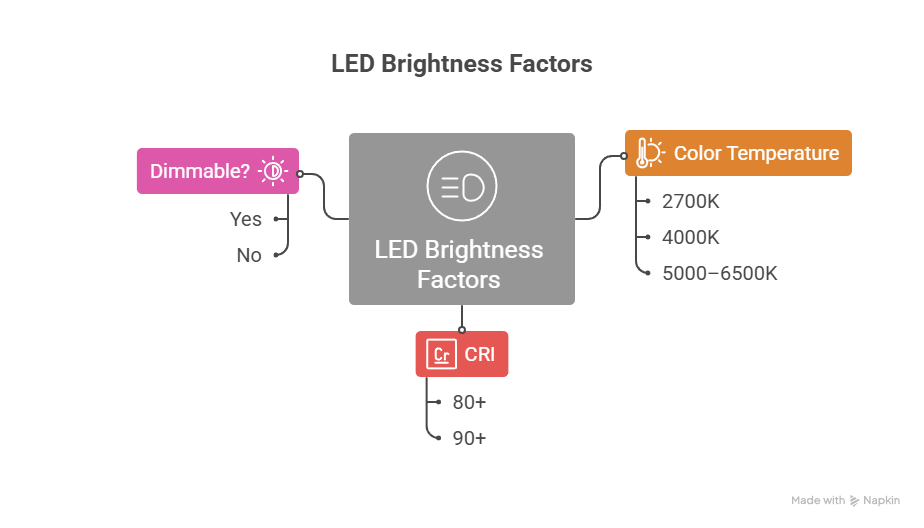
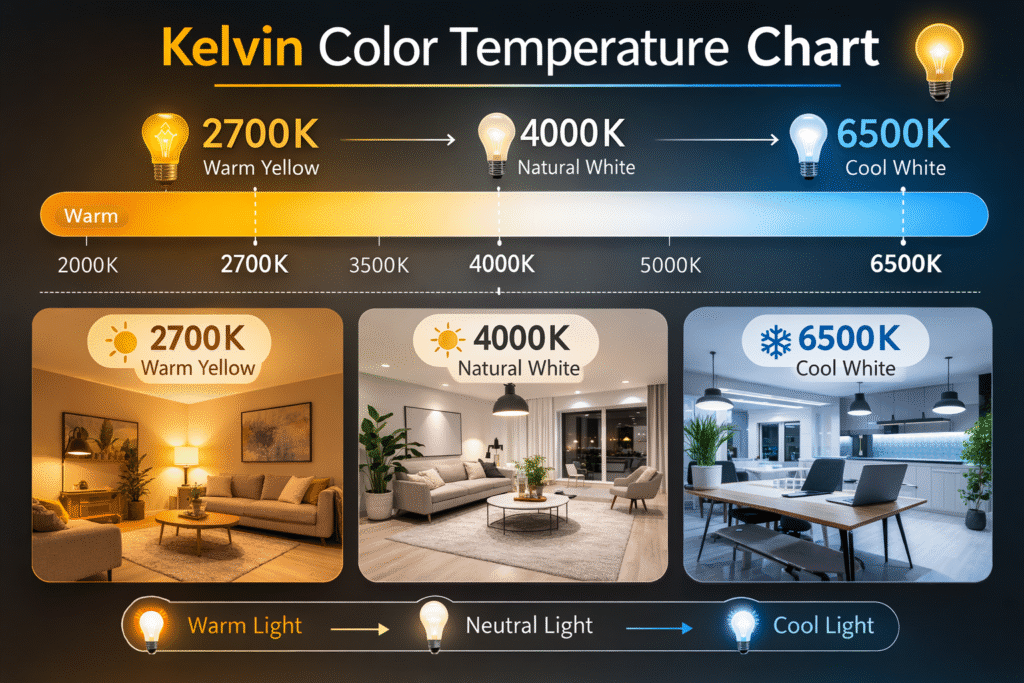
- Color Temperature (Kelvin):
- 2700K = Warm (cozy for living rooms & bedrooms)
- 4000K = Natural (daylight-like for kitchens & bathrooms)
- 5000–6500K = Cool white (great for offices & detailed tasks)
- CRI (Color Rendering Index): Choose 80+ (good) or 90+ (excellent) so colors appear true and vibrant—especially important in kitchens and bathrooms.
- Dimmable?: Opt for dimmable LEDs if you want to adjust brightness levels.
Common Questions About the Right LED Brightness
Can a 10-watt LED be brighter than an old 60-watt bulb?
Yes—if it outputs 800+ lumens, it matches or exceeds the brightness while using far less electricity.
What’s the best light color for the whole house?
No single color fits all—use warm (2700K) in living rooms and bedrooms, natural (4000K) in kitchens and bathrooms.
If the room is large, is one very bright bulb enough?
No—layer your lighting (ceiling + walls + floor) for even, eye-friendly illumination.
Final Thoughts
In 2026, forget watts when thinking about brightness—it’s just your electricity usage. Focus on lumens to always find the Right LED Brightness that suits your needs, saves energy, and keeps your eyes comfortable.
Quick shopping checklist:
- Measure your room’s area.
- Decide the room’s main purpose (relax, cook, work…).
- Use the table or formula to estimate needed lumens.
- Choose a high-efficiency LED (low watts, high lumens).
- Pick the right color temperature and CRI.
This approach ensures perfect, energy-efficient lighting every single time.
Sources :
- Lumens to Watts Conversion Chart: Choose the Right LED Bulb
- Lumens to Watts Conversion Chart (LEDVANCE – professional guide)
- Lumen to Watt Comparison – Energy vs Brightness