When people buy LED lights, they usually focus on three things:
- watt
- brightness
- price
But there is one important detail many people forget:
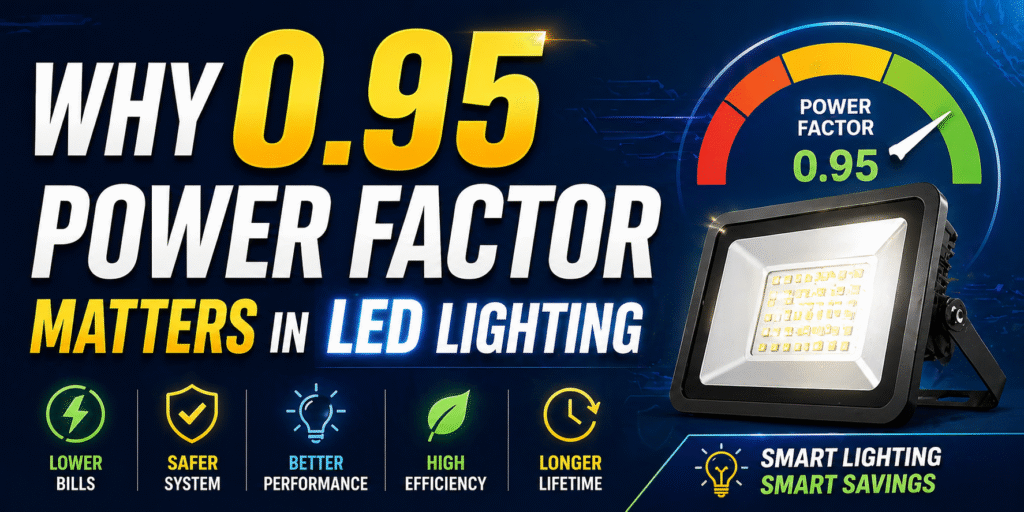
Power Factor in LED
This small number can make a big difference in your electricity bill, lighting quality, and electrical safety.
A high Power Factor in-LED means your light uses electricity efficiently and wastes less power.
A low Power Factor in LED means part of the electricity you pay for is lost inside wires, drivers, and transformers without giving you useful light.
That is why many professionals always check Power-Factor in LED before buying any floodlight, panel light, or commercial lighting fixture.
The best choice is usually: Power-Factor in LED>0.95Power\ Factor\ in\ LED > 0.95Power-Factor in LED>0.95
This means better performance, better savings, and better system reliability.
What Is Power Factor in LED?
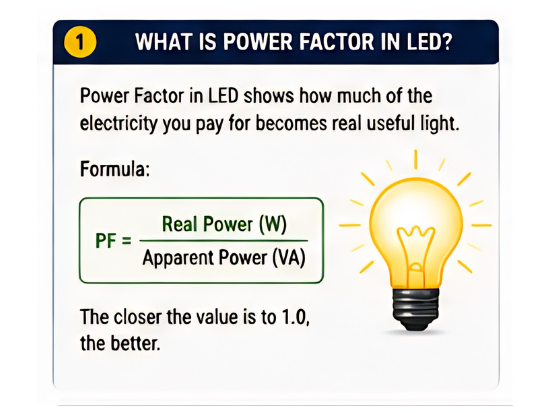
Let us explain Power Factor in LED in a very simple way.
It means:
How much of the electricity you pay for becomes real useful light.
Imagine you pay for 100 units of electricity.
The question is:
How much of that becomes actual lighting?
That answer is the Power-Factor in LED.
The closer the value is to 1.0, the better.
This means less waste and better efficiency.
Simple Example of Power Factor in LED
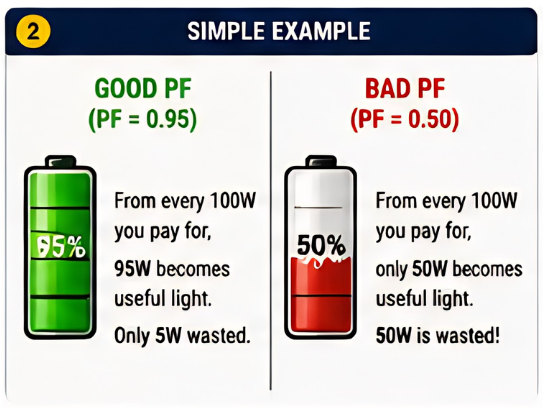
Good Power Factor in LED
If the light has:PF=0.95PF = 0.95PF=0.95
This means:
From every 100 units of electricity,
95 units become useful lighting.
Only 5 units are wasted.
This is excellent.
This is why a high Power-Factor in LED is always recommended.
Bad Power Factor in LED
If the light has:PF=0.50PF = 0.50PF=0.50
This means:
From every 100 units of electricity,
only 50 units become useful lighting.
The other 50 units are wasted.
You pay for them, but you do not benefit from them.
This is why low Power-Factor in LED is a bad investment.
What Is Ghost Power?
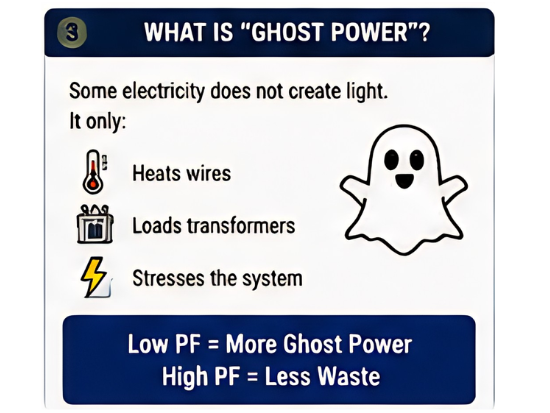
Some electricity does not create light.
It only:
- heats wires
- loads transformers
- stresses the electrical system
This is called:
Ghost Power
Low Power-Factor in LED creates more ghost power.
High Power-Factor in LED reduces it.
This helps your system stay cooler, safer, and more efficient.
Why Power Factor in LED Matters in Egypt
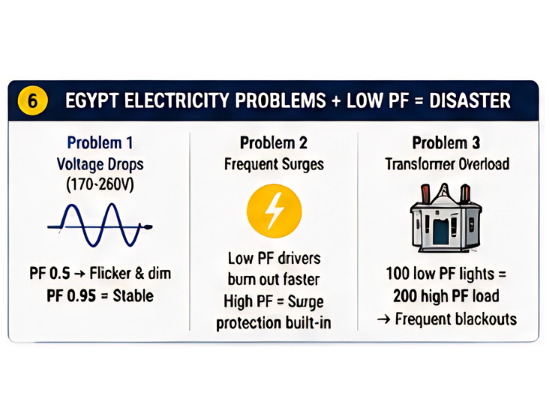
Electricity prices keep increasing.
Also, voltage problems happen often.
Examples include:
- voltage drops
- sudden surges
- unstable power supply
- transformer overload
Cheap low-quality drivers with poor Power-Factor in LED make these problems worse.
Good LED lights with strong Power-Factor in LED help reduce these issues.
That is why checking Power-Factor in LED is very important in Egypt.
Real Example for Your Electricity Bill
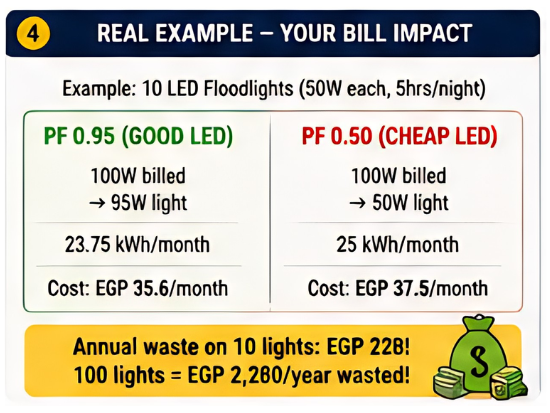
Let us compare two floodlights.
Same brightness.
Same watt.
Different Power-Factor in LED.
Example: 10 LED Floodlights
Each light:
50W
Working time:
5 hours every night
Total:
10 lights
Good LED Light
Power Factor in LED = 0.95
This gives:
- lower monthly electricity bill
- stable light output
- longer lifetime
- less heat
- safer wiring
This is the professional choice.
Cheap LED Light
Power Factor in LED = 0.50
This gives:
- higher electricity waste
- more hidden cost
- more heat
- shorter lifetime
- unstable performance
This becomes expensive later.
Annual Waste from Low Power Factor in LED
With only 10 lights,
you may waste more than:
200 EGP every year
only because of poor Power-Factor in LED.
In offices, villas, factories, and shops,
the waste becomes much larger.
This is why cheap lighting often becomes expensive.
Why Power Factor in LED 0.95 Is the Best Choice
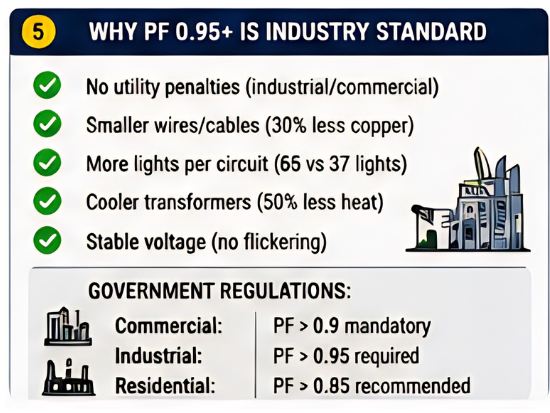
A value of:PF=0.95PF = 0.95PF=0.95
is considered excellent.
This is the standard used in:
- offices
- factories
- hospitals
- malls
- street lighting
- government projects
Because strong Power-Factor in LED gives the best balance between:
- savings
- safety
- stable lighting
- long lifetime
This is why engineers always target high Power-Factor in LED.
Benefits of High Power Factor in LED
Lower Electricity Bills
Less wasted electricity means lower monthly cost.
This is the first benefit of better Power-Factor in LED.
More Lights on One Circuit
You can connect more lights safely on the same breaker.
This reduces wiring cost and improves installation design.
A high Power-Factor in LED helps circuit efficiency.
Less Heat
Low PF creates extra heat.
Heat damages:
- wires
- LED drivers
- transformers
High Power-Factor in LED keeps the system cooler.
Stable Lighting
High Power -Factor in LED helps reduce:
- flickering
- dim lighting
- unstable brightness
This improves comfort and performance.
Longer Lifetime
Better drivers last longer.
This means:
- fewer replacements
- less maintenance
- lower repair cost
This makes high Power-Factor in LED a smart investment.
How to Check Power Factor in LED Before Buying
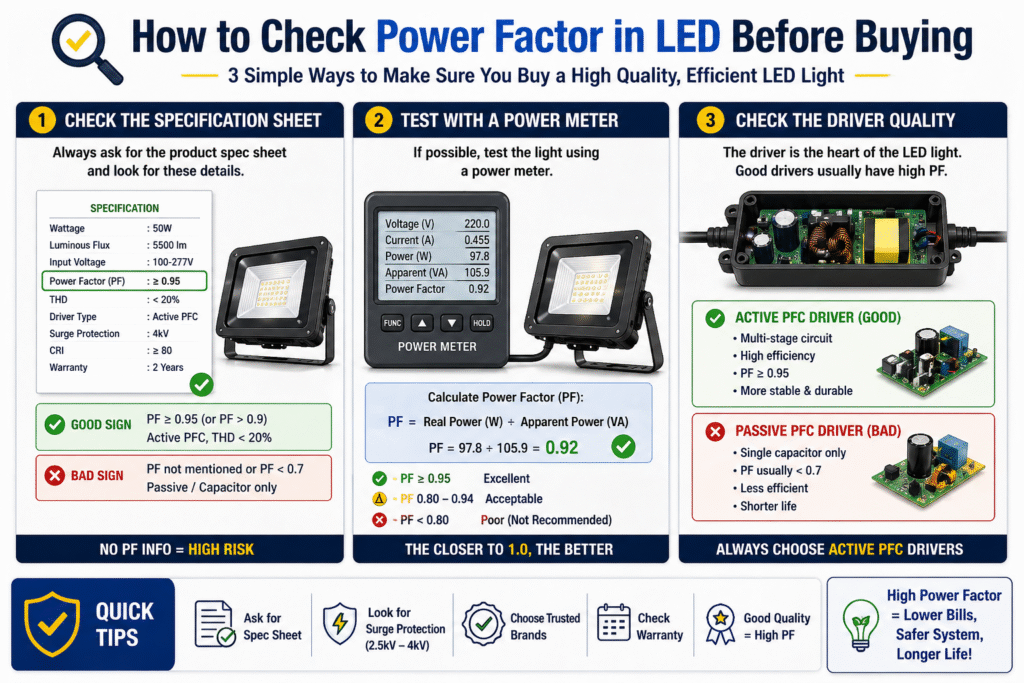
Before buying any LED light, check the specifications.
Always ask about Power-Factor in LED.
Good Signs
Choose lights with:
- PF above 0.95
- Active PFC
- surge protection
- trusted driver brand
- warranty included
These are signs of good Power-Factor in LED quality.
Warning Signs
Avoid products with:
- no PF written
- PF only 0.5
- unknown cheap brand
- no surge protection
- no warranty
These usually mean poor Power-Factor in LED.
Trusted Brands
Good brands often provide better drivers and stronger Power -Factor in LED, such as:
Signify
LEDVANCE
Mean Well
These brands focus on quality, safety, and long-term savings.
Home Example Using Power Factor in LED
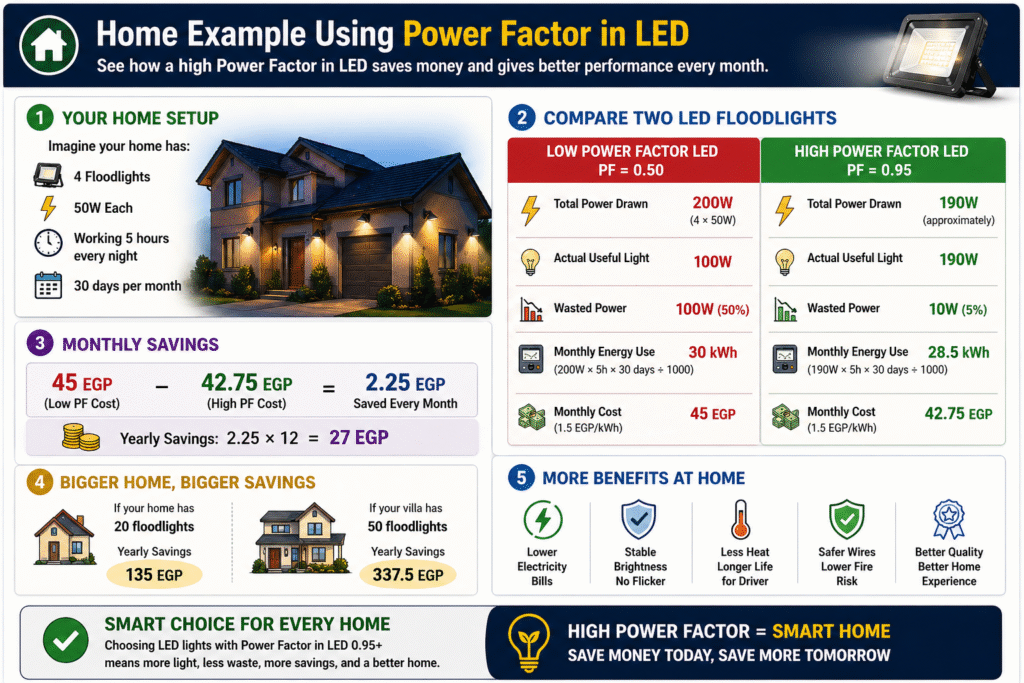
Imagine your garden has:
4 floodlights
Each one:
50W
If you choose cheap lights with poor Power-Factor in LED,
you waste money every month.
If you choose better lights with strong Power-Factor in LED,
you save money every year.
Even in small homes, the difference is clear.
For villas and large buildings, the savings become much bigger.
Dangers of Low Power Factor in LED
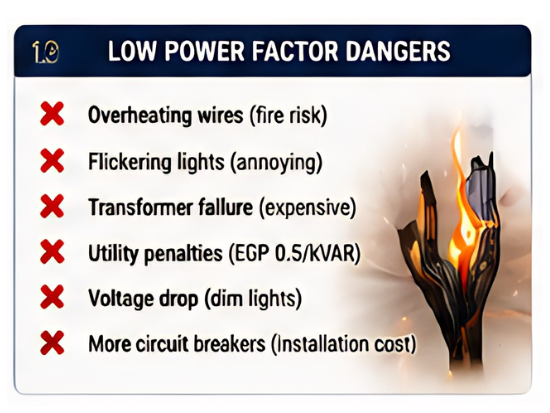
Low Power-Factor in LED is not only about money.
It can also cause:
- overheating wires
- circuit breaker trips
- transformer overload
- fire risk
- weak lighting
- driver failure
- shorter lamp life
That is why low Power Factor in LED should never be ignored.
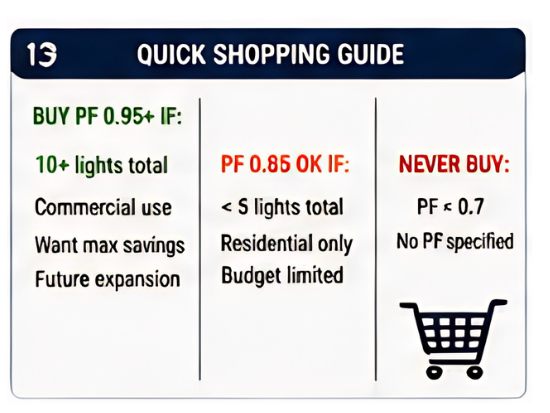
Quick Buying Guide
Buy High Power Factor in LED If
- you have many lights
- it is a shop or office
- it is a factory
- it is street lighting
- you want long-term savings
This means you should choose:
PF 0.95+
PF 0.85 Is Acceptable If
- very small home use
- very few lights
- budget is limited
Still, better Power Factor in LED is always preferred.
Never Buy
- PF below 0.7
- no PF information at all
This is usually a poor investment.
Common Question About Power Factor in LED
Does Power Factor in LED Change Brightness?
No.
Brightness depends on:
lumens
not directly on Power Factor in LED.
Power Factor affects:
- efficiency
- electricity waste
- wiring safety
- system stability
This is why it still matters a lot.
Final Conclusion
Power Factor in LED may look like a small technical number,
but it creates a big difference.
A good LED light should have:PF>0.95PF > 0.95PF>0.95
This gives you:
- lower bills
- safer wiring
- less heat
- better stability
- longer lifetime
- stronger electrical performance
Cheap low PF lighting may look cheaper today,
but it costs more later.
Smart lighting is not only bright.
Smart lighting means choosing strong Power Factor in LED.
Choose wisely.
Choose high Power Factor in LED.
Sources :
- Power Factor in LED Lighting Systems
- PF>0.95 Requirements for Commercial Project
- Active PFC vs Passive in LED Drivers