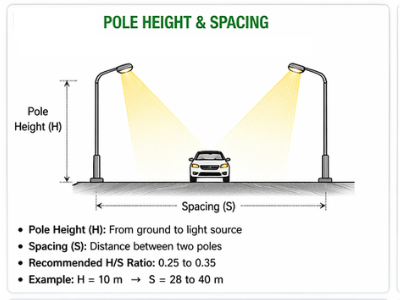
This table is the main reference engineers use when they want to Choose Street Lights Based on Road Width.
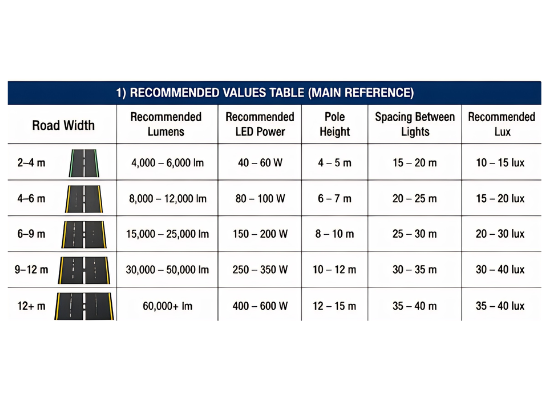
| Road Width | Recommended Lumens | Recommended LED Power | Pole Height | Spacing Between Lights | Recommended Lux |
|---|---|---|---|---|---|
| 2–4 m | 4,000–6,000 lm | 40–60 W | 4–5 m | 15–20 m | 10–15 lux |
| 4–6 m | 8,000–12,000 lm | 80–100 W | 6–7 m | 20–25 m | 15–20 lux |
| 6–9 m | 15,000–25,000 lm | 150–200 W | 8–10 m | 25–30 m | 20–30 lux |
| 9–12 m | 30,000–50,000 lm | 250–350 W | 10–12 m | 30–35 m | 30–40 lux |
| 12+ m | 60,000+ lm | 400–600 W | 12–15 m | 35–40 m | 35–40 lux |
This table helps you quickly decide the correct lighting system before installation.
1. Choose Street Lights Based on Road Width for Narrow Roads (2–4 m)
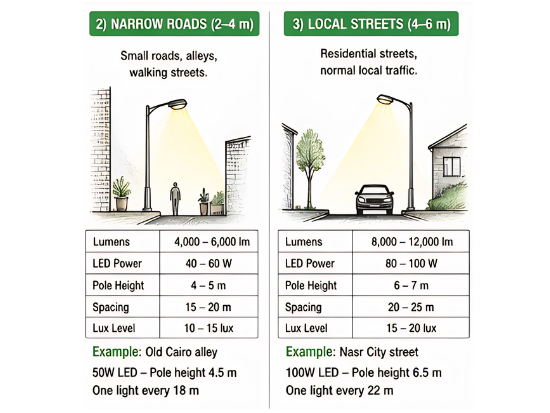
These are small roads, alleys, walking streets, and local access roads.
Cars move slowly and people walk more.
That means we do not need very strong lighting. We need soft, balanced, and comfortable lighting.
Recommended Values
| Item | Value |
|---|---|
| Lumens | 4,000–6,000 lm |
| LED Power | 40–60 W |
| Pole Height | 4–5 m |
| Spacing | 15–20 m |
| Lux Level | 10–15 lux |
Practical Example
If you have a small alley in Old Cairo:
- Use 50W LED
- Pole height = 4.5 meters
- One pole every 18 meters
This gives safe walking visibility without wasting electricity.
This is a simple example of how to Choose Street Lights Based on Road Width correctly.
2. Choose Street Lights Based on Road Width for Local Streets (4–6 m)
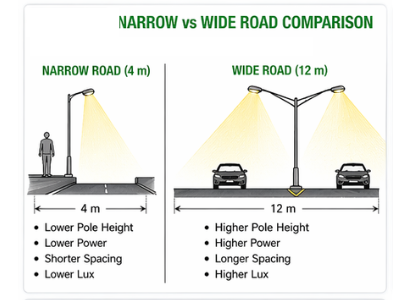
These are normal streets inside residential areas like neighborhoods and housing zones.
Cars move daily and people use these roads often.
Lighting must be stronger than narrow roads.
Recommended Values
| Item | Value |
|---|---|
| Lumens | 8,000–12,000 lm |
| LED Power | 80–100 W |
| Pole Height | 6–7 m |
| Spacing | 20–25 m |
| Lux Level | 15–20 lux |
Practical Example
For a local street in Nasr City:
- Use 100W LED
- Pole height = 6.5 meters
- One light every 22 meters
This creates clear visibility and saves around 70% electricity compared to old sodium lamps.
This is why engineers always Choose Street Lights Based on Road Width before purchasing.
3. Choose Street Lights Based on Road Width for Main Roads (6–9 m)
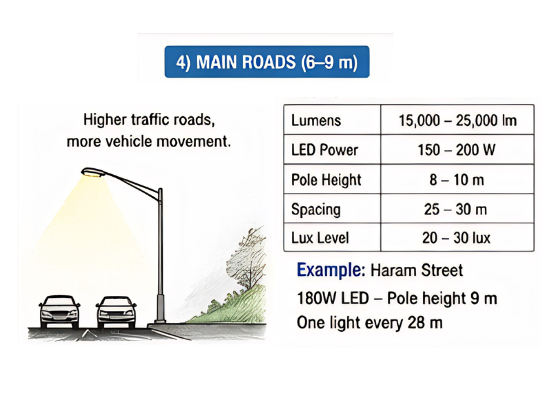
These roads carry more traffic and faster movement.
Drivers need stronger lighting and better beam coverage.
Recommended Values
| Item | Value |
|---|---|
| Lumens | 15,000–25,000 lm |
| LED Power | 150–200 W |
| Pole Height | 8–10 m |
| Spacing | 25–30 m |
| Lux Level | 20–30 lux |
Practical Example
For a road like Haram Street:
- Use 180W LED
- Pole height = 9 meters
- One pole every 28 meters
This gives strong lighting and safer night driving.
This is another clear case where we must Choose Street Lights Based on Road Width and not by guesswork.
4. Choose Street Lights Based on Road Width for Wide Roads (9–12 m)
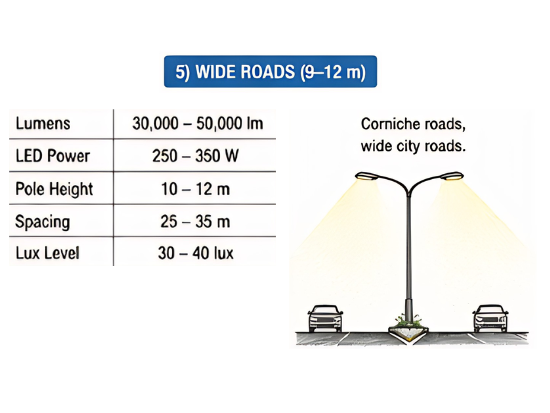
These include Corniche roads and large city roads.
These roads need wider beam coverage and stronger illumination.
Recommended Values
| Item | Value |
|---|---|
| Lumens | 30,000–50,000 lm |
| LED Power | 250–350 W |
| Pole Height | 10–12 m |
| Spacing | 30–35 m |
| Lux Level | 30–40 lux |
Practical Example
For Nile Corniche:
- Use 300W LED
- Pole height = 11 meters
- One light every 32 meters
This supports traffic flow and improves visibility during night driving.
This is why planners must always Choose Street Lights Based on Road Width first.
5. Choose Street Lights Based on Road Width for Highways and Ring Roads (12+ m)
These are high-speed roads where dark zones become very dangerous.
Lighting must be strong, high, and uniform.
Recommended Values
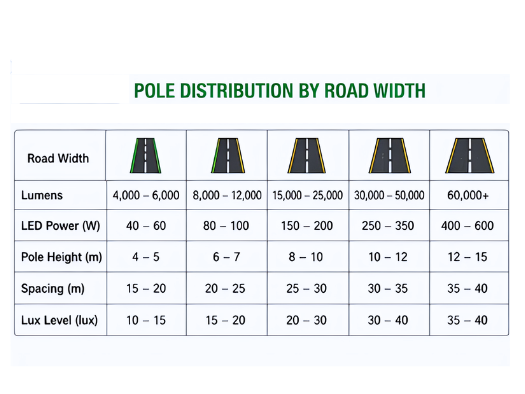
Practical Example
For Ring Road:
- Use 500W LED
- Pole height = 14 meters
- Large beam angle design
This supports safe driving at high speed and reduces accident risks.
This is one of the strongest examples of why we must Choose Street Lights Based on Road Width carefully.
Simple Formula to Choose Street Lights Based on Road Width
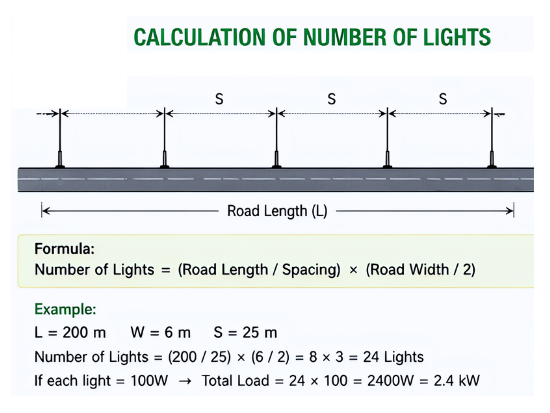
To estimate the number of street lights needed, use this simple formula:Number of Lights=(Road LengthSpacing)×(Road Width2)\text{Number of Lights} = \left( \frac{\text{Road Length}}{\text{Spacing}} \right) \times \left( \frac{\text{Road Width}}{2} \right)Number of Lights=(SpacingRoad Length)×(2Road Width)
This helps in planning the total project cost.
Example Calculation
Road length = 200 meters
Road width = 6 meters
Recommended spacing = 25 metersNumber of Lights=(20025)×(62)\text{Number of Lights} = \left( \frac{200}{25} \right) \times \left( \frac{6}{2} \right)Number of Lights=(25200)×(26)=8×3=24= 8 \times 3 = 24=8×3=24
Final result:
You need 24 street lights.
If each light is 100W:24×100=2400W=2.4kW24 \times 100 = 2400W = 2.4kW24×100=2400W=2.4kW
Total electrical load = 2.4 kW
This is how professionals Choose Street Lights Based on Road Width using calculations instead of assumptions.
Best LED Type to Choose Street Lights Based on Road Width
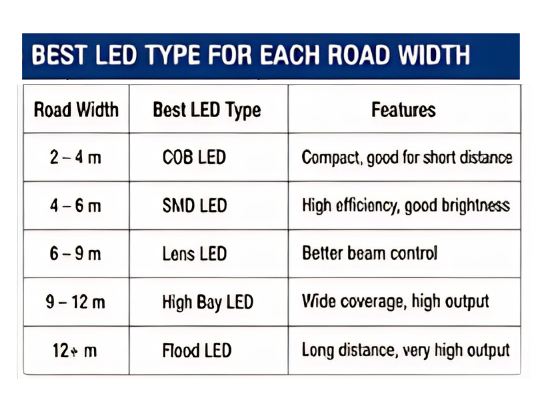
Different roads need different fixture designs.
| Road Width | Best LED Type |
|---|---|
| 2–4 m | COB LED |
| 4–6 m | SMD LED |
| 6–9 m | Lens LED |
| 9–12 m | High Bay LED |
| 12+ m | Flood LED |
The correct LED type improves beam direction, coverage, and maintenance life.
Choosing only by watt is a common mistake.
Common Mistakes When You Do Not Choose Street Lights Based on Road Width
Many projects fail because people ignore professional lighting rules.
Common mistakes include:
- Choosing by watt only
- Ignoring lumen output
- Low pole height
- Very large spacing
- Using old fluorescent fixtures
- No lux calculation
- Wrong beam angle selection
These mistakes increase:
- Electricity bills
- Maintenance cost
- Dark spots
- Traffic accidents
- Legal problems
That is why the correct solution is always to Choose Street Lights Based on Road Width.
Smart Solutions for Better Street Lighting
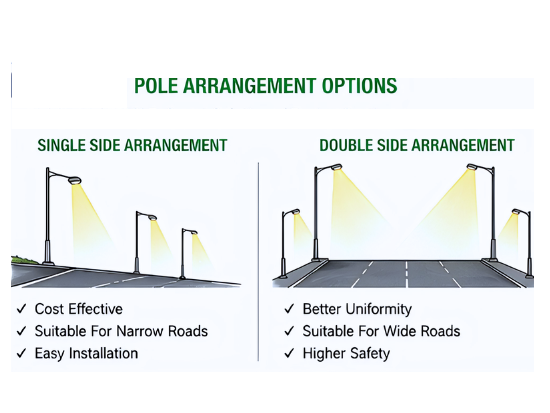
Modern street lighting projects should include smart systems like:
- Motion sensors
- Auto dimming
- Remote IoT control
- Fault alarms
- Central monitoring system
- Smart scheduling systems
These reduce electricity cost and improve maintenance speed.
Smart control becomes even better when you first Choose Street Lights Based on Road Width correctly.
Cost Example for 1 km Road
Road length = 1000 meters
Road width = 6 meters
Spacing = 25 meters
Number of lights:1000÷25=401000 \div 25 = 401000÷25=40
Total lights needed = 40
Each light:
- 100W LED
- Price = 4,500 EGP
Total project cost:40×4500=180,000 EGP40 \times 4500 = 180,000 \text{ EGP}40×4500=180,000 EGP
Annual electricity savings:
Around 120,000 EGP
Return on investment:
About 18 months
This proves that when you Choose Street Lights Based on Road Width, you save money and improve performance.
Final Conclusion
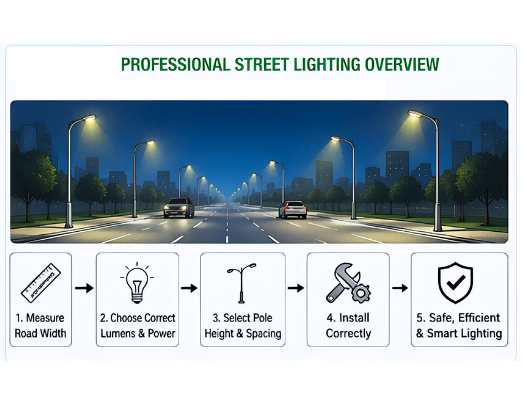
The most important rule in road lighting is simple:
Choose Street Lights Based on Road Width
Do not start with watt.
Do not start with price.
Start with road width.
Then choose:
- Correct lumen value
- Correct pole height
- Correct spacing
- Correct lux level
- Correct LED fixture type
This gives you:
- Better safety
- Lower bills
- Strong visibility
- Legal compliance
- Faster return on investment
Professional lighting always starts with one decision:
Choose Street Lights Based on Road Width.
Sources :
- CIE – International Commission on Illumination
- Egyptian Code for Street Lighting – ECP 501
- Roadway Lighting Design Guide and Recommended Practice