When choosing lighting solutions, many decisions are driven by upfront cost. While price is an important factor, it should never be the primary criterion. In reality, Lighting Quality has a far greater impact on safety, performance, comfort, and long-term cost efficiency than the initial purchase price. Poor lighting choices often lead to hidden expenses, reduced productivity, and compromised user experience.
This article explains why Lighting Quality should be prioritized over price, especially in professional, commercial, and public environments.
1. Understanding Lighting Quality
Lighting Quality refers to how effectively a lighting system supports visual tasks and human comfort. It is not defined by brightness alone. High-quality lighting combines several technical and perceptual factors that work together to create a reliable and comfortable visual environment.
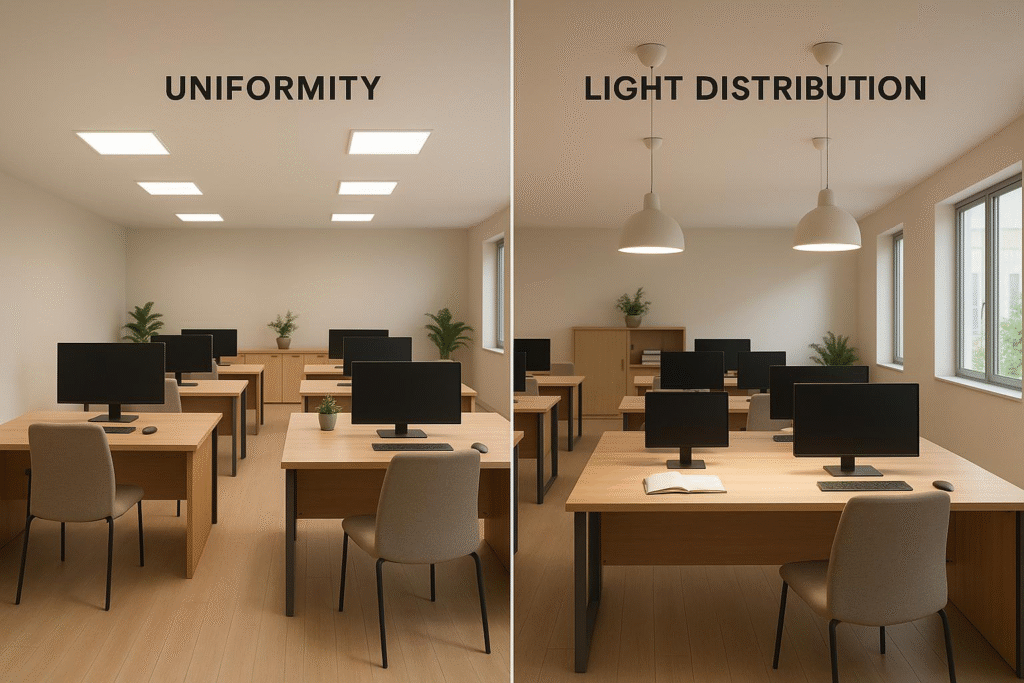
Key elements of Lighting Quality include:
- Uniform light distribution
- Accurate color rendering
- Proper color temperature
- Minimal glare
- Stable light output over time
A low-cost fixture may deliver sufficient brightness initially, but without proper Lighting Quality, its performance quickly declines.
2. The Hidden Cost of Poor Lighting Quality
Low-priced lighting products often reduce manufacturing cost by compromising internal components, optical design, or thermal management. These compromises are not always visible at installation but appear over time.
Poor Lighting Quality can result in:
- Frequent failures and replacements
- Increased maintenance labor
- Higher energy consumption
- Reduced lifespan
- Visual discomfort and eye strain
When these factors are considered, the apparent savings of low-cost lighting disappear.
3. Lighting Quality and Visual Performance
Human vision relies heavily on consistent and well-balanced illumination. In workplaces, schools, hospitals, and public spaces, Lighting-Quality directly affects how people see, react, and perform tasks.
High Lighting-Quality improves:
- Reading accuracy
- Depth perception
- Object recognition
- Reaction time
Poor lighting increases visual fatigue and error rates, especially during long operating hours.
4. The Role of Color Rendering in Lighting Quality
Color Rendering Index (CRI) is a critical component of Lighting-Quality. It measures how accurately colors appear under artificial light compared to natural daylight.
High Lighting-Quality lighting systems:
- Reveal true object colors
- Improve facial recognition
- Support accurate decision-making
Low CRI lighting may be cheaper, but it distorts colors and reduces visual clarity, which can be problematic in retail, healthcare, and industrial environments.
5. Lighting Quality and Safety

Safety is closely linked to Lighting-Quality. Inadequate or uneven lighting increases the risk of accidents, misjudgment, and delayed response.
High Lighting-Quality enhances safety by:
- Reducing shadows and dark spots
- Improving visibility of obstacles
- Supporting surveillance systems
- Enhancing pedestrian and vehicle awareness
In safety-critical areas, price-based lighting decisions often lead to unacceptable risks.
6. Energy Efficiency Depends on Lighting Quality

Many low-cost lighting products claim high efficiency, but real-world performance often differs. Lighting-Quality ensures that light is delivered where it is needed, without waste.
High Lighting-Quality systems:
- Use optics to control light distribution
- Reduce over-lighting and glare
- Maintain stable output over time
Cheap fixtures may consume less power initially, but their rapid degradation increases energy use and replacement frequency.
7. Impact of Lighting Quality on Productivity
In offices, factories, and educational spaces, Lighting-Quality directly influences productivity. Comfortable lighting reduces distraction and fatigue, allowing people to focus longer and perform better.
Studies show that good Lighting-Quality:
- Reduces headaches and eye strain
- Improves concentration
- Supports consistent performance
Low-quality lighting creates discomfort that cannot be corrected by simply increasing brightness.
8. Lighting Quality and Long-Term Cost
While high-quality lighting systems may cost more upfront, they deliver significant savings over their lifetime.
Long-term benefits of Lighting-Quality include:
- Longer service life
- Lower maintenance costs
- Reduced downtime
- Consistent performance
When evaluated over several years, Lighting-Quality almost always proves more economical than low-cost alternatives.
9. Durability and Reliability as Part of Lighting Quality
Lighting-Quality is closely tied to fixture construction and component selection. High-quality luminaires use:
- Efficient thermal management
- Durable housings
- Reliable drivers
- Stable LED modules
Low-priced products often fail prematurely due to overheating or component degradation.
10. Lighting Quality in Professional Applications
In professional environments, lighting is part of system performance, not decoration. Hospitals, schools, industrial facilities, and public infrastructure require Lighting quality that supports safety, accuracy, and compliance.
Price-driven decisions may work for short-term applications, but professional spaces demand reliability and consistency.
11. How to Evaluate Lighting Quality Beyond Price
To assess Lighting Quality, decision-makers should consider:
- Photometric data and light distribution
- CRI and color consistency
- Flicker performance
- Thermal design
- Manufacturer reliability and warranty
A higher upfront price often reflects better engineering rather than unnecessary cost.
Conclusion
Price is visible at purchase, but Lighting quality defines performance for years. Low-cost lighting solutions frequently introduce hidden expenses through maintenance, energy waste, and reduced comfort. High Lighting-quality, on the other hand, delivers safety, efficiency, durability, and long-term value.
Choosing Lighting-Quality over price is not an expense—it is an investment in performance, reliability, and user well-being.